HVAC Industry Trends 2026: What Owners Need to Know.
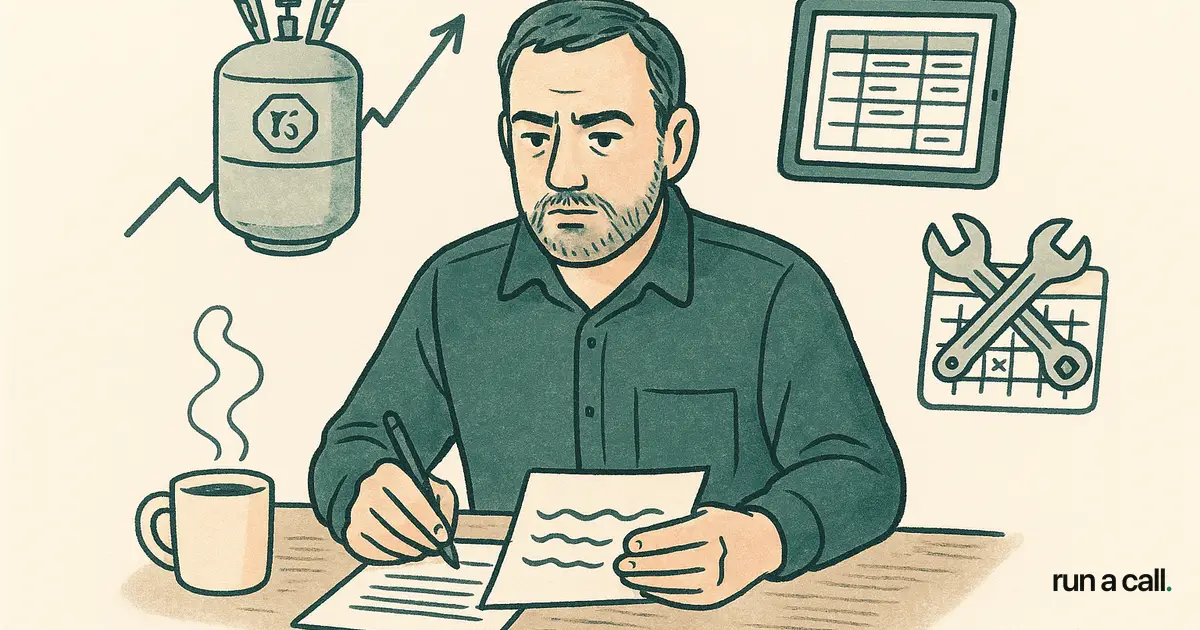
A residential HVAC owner I talked to last month runs eight techs in a Sun Belt metro. His revenue is up 11% year over year. His net margin is down four points. He can't hire a fourth install lead at any wage he's willing to pay, and his distributor just told him R-454B inventory is tight through summer. He asked me a fair question: is this just my shop, or is this everyone right now? It's everyone. The HVAC industry trends shaping 2026 — the A2L refrigerant transition, a labor pipeline that doesn't replace retirees, and software costs eating margin from the top — are landing on every 5-25 tech residential shop at roughly the same time. This piece is the version I'd want if I were running your shop: numbers, sources, and what to actually do about each one.
Where the HVAC industry actually sits in 2026
The U.S. residential HVAC market is roughly a $130B services industry with a mature replacement cycle, an aging installed base, and a refrigerant transition happening on top of both. IBISWorld pegs the contractor segment around that range with low-single-digit annual growth (IBISWorld). That growth number hides what's actually happening on the ground.
Demand is bifurcating. Replacement demand is strong because the equipment installed during the 2003-2008 housing boom is hitting end-of-life on schedule. New construction is uneven — strong in Texas, Florida, Carolinas; soft almost everywhere with high mortgage rates biting. Service shops that are 70%+ residential replacement are the ones quietly having their best years.
Margin is tighter than revenue suggests. Equipment cost inflation, A2L transition costs, wage pressure, and software fees have all moved up at the same time. The shops doing well aren't growing into the margin — they're protecting it with maintenance agreements and tighter dispatch.
The ServiceTitan IPO in late 2024 (ServiceTitan) put public numbers on something owners already felt: the software vendor charging you per-tech is now answerable to public-market growth expectations. That changes how prices move. More on that further down.
How big is the HVAC labor shortage, and what does it cost a 10-tech shop?
The Bureau of Labor Statistics projects roughly 37,700 HVAC mechanic and installer job openings per year through 2032, driven mostly by retirements and industry growth (BLS). Trade school output is nowhere near that. The math doesn't balance, and it won't this decade.
For a 10-tech residential shop, the practical cost shows up in three places. Wages: senior service techs in major metros are now $38-$52/hr base before SPP and bonus, up from $30-$42 four years ago. Time-to-fill: 60-90 days for a senior tech is normal, 120+ days isn't unusual. Promotion pressure: helpers are getting put in trucks before they're ready, which raises callback rates.
Callbacks are the hidden tax. A shop running 12% callback on its newer techs is burning roughly one truck-day per week per tech on rework. That's $1,500-$2,500 of lost billable revenue per tech per week. Multiply across the bench and the labor shortage isn't a hiring problem anymore — it's a margin problem.
The shops that handle this well do two things. They build a real apprentice ladder with documented ride-along hours and skills checklists, so a new hire produces billable work in month two instead of month six. And they use dispatch software that routes the right tech to the right call — customer-favorite-tech rules, install vs. service split, and explainable AI dispatch that the dispatcher can override and learn from. The cheap version of that fix is process. The scaled version is software that doesn't fight you.
What does the R-410A phase out mean for residential shops right now?
New residential central AC and heat pump equipment manufactured in the U.S. had to use A2L refrigerants — primarily R-454B and R-32 — starting January 1, 2025, under the EPA AIM Act HFC phasedown (EPA). R-410A equipment already in the field keeps running. New R-410A equipment production is done.
What that means in your truck this week: every system replacement quote is now an A2L system. Your install techs need ACCA-aligned A2L training, mildly different brazing and leak-check procedures, and updated leak-detection equipment because A2Ls are mildly flammable (Class 2L). Local code on charge limits per occupied space is starting to matter for ductless work.
What it means in your parts room: R-410A reclaim and existing stock will service the installed base for years, but pricing is volatile. Shops are already seeing $400-$700 jugs on the spot market when distributors run thin. Build R-410A surcharge language into your service agreements now if you haven't.
What it means in your pricebook: every line item that touches refrigerant needs a refresh. Recovery, evacuation, charging — labor times don't change much, but materials do, and your A2L line items need to reflect actual local distributor pricing. Shops still running a 2022 pricebook on A2L work are leaving 8-15% on the table per ticket. The fix is straightforward: a maintained pricebook your techs trust on the tablet. We've written more on building an HVAC pricebook techs will actually use.
What are realistic HVAC business benchmarks for revenue per technician?
$250K to $350K of revenue per service technician per year is the working band for a healthy residential shop. Install techs run higher on gross — $500K-$800K per install tech is normal — but lower on net margin per dollar. If your service techs are clearing under $200K on full schedules, the bottleneck isn't the tech.
Here's the rough math for a 10-tech shop split 6 service / 4 install: 6 × $300K + 4 × $600K = $4.2M. Add a maintenance base of 800 active agreements at $200/yr and you're at $4.36M. That's the ceiling a well-run 10-tech residential shop can credibly hit. Shops doing $2.8M with the same headcount aren't lazy — they have process leaks.
The leaks are usually in three places. Average ticket: anything under $450 on residential service calls in 2026 means your pricebook or your sales process is underpriced. Close rate on system replacements: under 35% means your kitchen-table presentation or your comfort-advisor handoff is broken. Unbilled drive time: if dispatch can't see drive minutes per ticket, you can't bill or reduce them.
The other benchmark that matters: maintenance agreements per tech. A service tech should be supported by 100-150 active agreements. Below that, summer is feast and winter is famine. Shops with 800+ active agreements coming into a soft year survive it. Shops without don't.
The data sources here are messy — there's no clean public dataset for shop-level HVAC P&Ls, so most of these numbers come from operator surveys, ACCA member benchmarking, and our own conversations with 5-25 tech owners. Use them as directional, not gospel.
Software cost is now a line item — what owners are actually paying
Software cost has moved from a rounding error to a real line on HVAC shop P&Ls. Five years ago, a 10-tech shop spent maybe $400/mo on field software. In 2026, the same shop is often spending $2,500-$5,000/mo across dispatch, accounting integration, payments, and a pricebook tool. That's $30K-$60K a year, against $4M of revenue. Not catastrophic, but not free either.
ServiceTitan publicly reported per-tech pricing in the $245-$500/tech/mo range in their S-1 disclosures, with setup fees commonly $5K-$50K. For a 12-tech shop, that's $35K-$72K/yr just on the dispatch tool, before payments, integrations, or change orders. Their own filings note 2.9 outages per month with 188-minute average resolution as the operational reality you're paying that for.
The alternative most 5-25 tech shops are now looking at is flat-fee software. Run a Call ships at one flat monthly price per shop — dispatch, pricebook, QuickBooks Desktop sync, Stripe Connect payments, Twilio SMS, and explainable AI dispatch with thumbs feedback the dispatcher can train. No per-tech pricing, no setup fee for the shops that fit the profile. The point isn't that we're cheap. The point is that per-tech pricing punishes you for hiring, and the labor shortage means you're already getting punished enough.
If you're evaluating, the questions to ask any vendor: what's the published outage history, what's the cancellation cost, can you get your data out as CSV without paying a migration fee, and does the AI explain its dispatch suggestion or just pick a tech with no reasoning. The last one matters more than people expect — a black-box AI scheduler that the dispatcher doesn't trust gets overridden every time, which means you paid for software you don't use.
What should an owner actually do about these HVAC industry trends?
Pick the two that move the most money in your shop and ignore the rest until next quarter. For most 5-25 tech residential operations, those two are maintenance base growth and average ticket. Everything else compounds off those.
Maintenance base. If you're under 100 agreements per service tech, every other initiative is harder. Set a quarterly target — 50 net new agreements, every quarter, no exceptions — and tie a piece of CSR comp to it. The agreements protect you from a soft Q1, fund your tune-up season, and produce the demo equipment your install side closes against.
Average ticket. Audit your last 200 service tickets against your pricebook. Find the 10 most-run line items. If any of them haven't been repriced in the last 12 months — capacitor replacements, condenser fan motors, contactors, common refrigerant work — you're underpriced by definition. The A2L transition makes this worse if you haven't refreshed yet.
Dispatch. Walk your dispatch board for one full day next week. Count how many manual moves your dispatcher makes. If it's more than 15-20, your software is taxing your busiest person. Either fix the rules in the tool you have, or evaluate replacements. We wrote a longer piece on HVAC dispatch software for 5-25 tech shops that walks through evaluation criteria.
Software cost. Not urgent for everyone, but if you're on per-tech pricing and growing the bench, run the math on the next 18 months. A 12-tech shop adding three techs at $300/tech/mo is an extra $10,800/yr in software fees alone. That's a real number to weigh against migration friction. If you're already considering an exit, our ServiceTitan alternative for HVAC page covers the parallel-run pattern and CSV portability questions to ask before you sign anything new.
Labor. The trends here aren't reversing. Build the apprentice ladder, write down the ride-along checklist, and stop relying on poaching from competitors as your hiring strategy. The shops that win the next five years are the ones training their own.
Frequently asked
What is a healthy revenue-per-technician benchmark for an HVAC shop?
$250K-$350K per service tech per year is the working band most well-run residential shops hit. Install-heavy shops skew higher on gross but lower on margin. If your service techs are clearing under $200K and running full schedules, the leak is usually in average ticket, callback rate, or unbilled drive time — not technician effort.
How bad is the HVAC labor shortage actually?
BLS projects roughly 37,700 HVAC openings per year through 2032, mostly from retirements, against a training pipeline that doesn't come close to filling that gap ([BLS](https://www.bls.gov/ooh/construction-and-extraction/heating-air-conditioning-and-refrigeration-mechanics-and-installers.htm)). The practical impact: wage inflation 5-8% per year in most metros, longer time-to-fill on senior tech roles, and more shops promoting helpers earlier than they should.
When does R-410A actually go away?
New residential systems manufactured in the U.S. had to switch to A2L refrigerants (R-454B or R-32) starting January 1, 2026 under the EPA AIM Act. R-410A equipment already in the field keeps running. Reclaimed and existing R-410A stock will service that installed base for years, but new R-410A production is winding down on the EPA HFC phasedown schedule.
What's the average HVAC shop revenue for a 10-tech residential operation?
Rough math: 6 service techs at $300K plus 4 install techs at $600K lands around $4.2M. That's a healthy ceiling for a 10-tech shop with a real maintenance base and a 35%+ close rate on system replacements. Shops without a maintenance program or comfort-advisor handoff usually run 30-40% below that.
How do I know if my software is holding back my benchmarks?
Three signs: dispatchers manually rebuilding the board every morning, pricebook updates taking weeks to push to tablets, and your techs not trusting the close-rate number on their dashboard. If any of those are true, the software is taxing the benchmarks you're trying to hit. You can walk through Run a Call to see what a flat-per-shop setup looks like for a 5-25 tech shop.
Ready to switch HVAC software?
Walk through the dispatch board, pricebook, and mobile app in 30 minutes. No commitment.

Co-founder of run a call. Owns engineering. €6M of operational systems at Airbus, then an AI workflow-automation firm acquired by Transputec, now Head of Enterprise Automation there.
Read full bio →