HVAC Marketing: The Owner's Playbook for Booking More Calls.
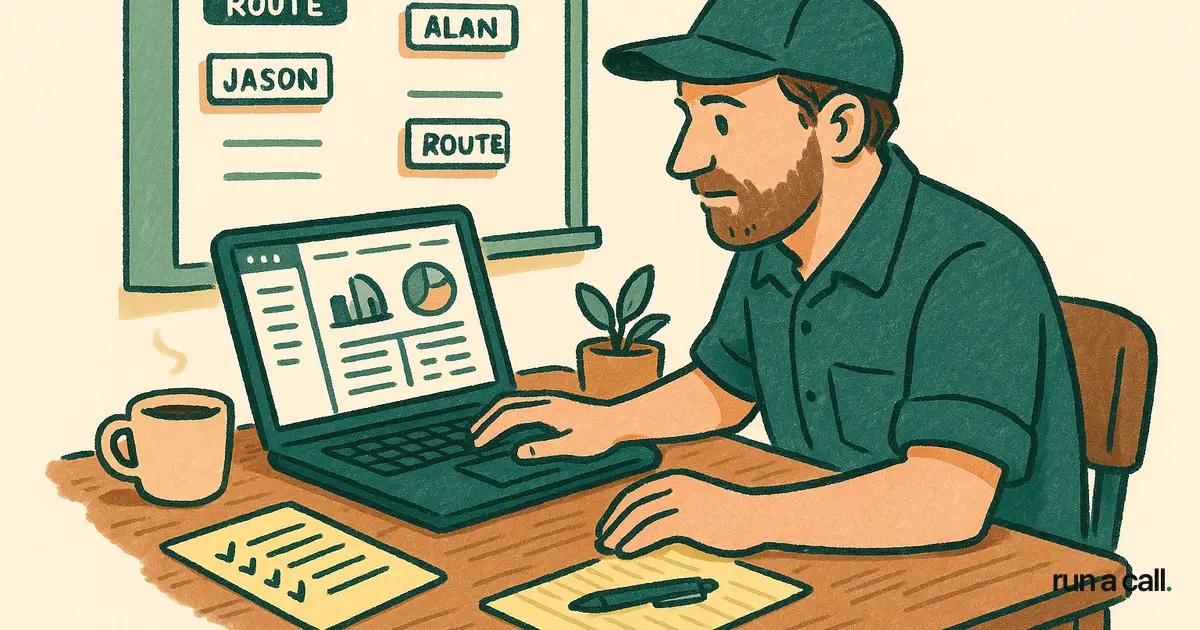
A shop owner in Phoenix told me last spring: "I just want to push a button and see where the business is coming from." He was spending $14,000 a month across four channels and couldn't tell me which one was paying for itself. His dispatcher was writing the lead source on sticky notes. His website form went to a Gmail inbox nobody checked after 5pm. That's HVAC marketing for most 5-25 tech shops. Not a strategy problem — a tracking problem dressed up as a strategy problem. This guide is how I'd run the marketing side of a residential shop today: which channels actually book calls, what to spend, what to measure, and where the cheap wins hide.
What does HVAC marketing actually need to do?
HVAC marketing has one job: book a call from a homeowner who has money and a problem, today. Everything else is preamble.
That sounds obvious until you watch how shops spend. Branded mugs. Sponsored Little League jerseys. A $40,000 website rebuild that took nine months. Meanwhile the phone rings at 7:42pm on a Sunday in July and goes to a voicemail nobody checks until Monday at 9.
The job splits into three honest buckets. Demand capture — the customer already knows their AC is dead and they're searching. Demand creation — the customer doesn't know yet, but they will, and you want to be the name they remember. Retention — the customer you already won, who should be calling you and not the new guy with the radio jingle.
Most residential shops under-invest in capture, over-invest in creation, and ignore retention entirely. That's backwards. Capture is the cheapest, fastest dollar in marketing. A homeowner Googling "AC not blowing cold" at 2pm in August is worth ten of anything else. Start there.
The owner's measure of truth is cost-per-booked-call by channel, not cost-per-click or impressions or any of the dashboard theater an agency will show you. If you don't know what a booked call costs from each source, you're not running marketing — you're funding it.
Which HVAC lead generation channels actually pay for themselves?
For a residential 5-25 tech shop, four channels do the heavy lifting: Google Local Services Ads, Google Search ads, organic local SEO, and your existing customer list. Everything else is a bonus.
Local Services Ads (LSAs) sit at the top of Google for service queries with the green Google Guarantee badge. You pay per lead — call or message — not per click. For HVAC, lead costs run roughly $25-$80 depending on metro, and the intent is the highest you can buy. The homeowner is calling because their system is down. Per Google's own documentation, LSAs require active license and insurance verification plus an ongoing review and response-time score (Google Local Services help).
Google Search ads come next. Bid on your money keywords: "ac repair [city]", "furnace replacement [city]", "hvac near me". Don't bid on "hvac" alone — you'll burn cash on tire-kickers and B2B searches. Run separate campaigns for emergency vs. replacement intent. Emergency converts faster but at lower ticket; replacement is patient money with a $7-15K ticket.
Organic local SEO is slower but free once it's working. Three things matter: a Google Business Profile that's filled out and reviewed weekly, service-area pages on your website for every town you cover (one page per town, not a single "service areas" list), and steady review velocity. The Bureau of Labor Statistics projects 6% growth in HVAC mechanic employment through 2032 (BLS data) — demand isn't the constraint; visibility is.
Your customer list is the channel everyone forgets. The cheapest call to book is a call from a customer you already won. Two emails a year, a fall and spring tune-up reminder, a maintenance member nudge in March and September. If your CRM can't pull "customers with no visit in 18 months" in 30 seconds, that's a software problem, not a marketing problem.
Facebook, Nextdoor, direct mail, radio, and truck wraps all have a place — but they're the third 25%, not the first. Get the first four right before you fund the rest.
How do HVAC Google Ads and Local Services Ads work together?
LSAs and Google Search ads are not the same thing, and shops that treat them as one bucket waste money. LSAs are pay-per-lead, lead-gated by Google's verification, and ranked by review count, response time, and your booking rate. Search ads are pay-per-click, you control the landing page, and you can bid on whatever keywords you want.
Run both. LSAs catch the ready-to-buy callers at the top of the page. Search ads catch the comparison shoppers, the after-hours form-fillers, and the long-tail queries LSAs don't cover ("mini-split installation cost", "R-410A vs A2L", "heat pump rebate [state]"). Energy Star maintains the federal rebate and tax credit lookups homeowners search for (Energy Star) — those queries are gold for change-out leads.
The LSA scoreboard is brutal and simple. Ranking is a function of: number of reviews, recency of reviews, response time to leads, dispute rate (how often you mark a lead as spam — Google audits this), and booking rate. A shop with 200 reviews and a 4-minute response time will outrank a shop with 50 reviews and a 2-hour response time, every time. Build the review machine first, then turn on LSA spend.
For Search, the structure that works for residential HVAC: one campaign for emergency repair, one for replacement/installation, one for maintenance/membership, one for branded (your shop's name). Tight ad groups — "ac repair" gets its own group, separate from "furnace repair". Single keyword ad groups for your top five money terms. Negative keywords from day one: "jobs", "training", "diy", "how to", "school", "free".
Landing pages matter more than ad copy. A click that lands on your homepage converts at maybe 3%. A click that lands on a page titled "Emergency AC Repair in [City] — Same-Day Service" with a phone number, a form, and three reviews converts at 8-12%. Build a landing page per service per city. Yes, it's tedious. It's also why your competitor with worse trucks and worse techs is outbooking you.
What makes an HVAC website book calls instead of just looking pretty?
A high-converting HVAC website does five things and stops. Phone number in the header on every page. A booking form that texts the dispatcher in real time. Service-area pages for every town and ZIP you cover. Review snippets pulled from Google. Schema markup so Google knows you're a local business with hours, service area, and ratings.
That's it. The hero video, the chatbot, the 14-page "About Our Family" section, the stock photo of a smiling tech who isn't on your payroll — none of it books calls. It makes the owner feel good when the agency demos it. That's a different metric.
Mobile-first is not optional. Roughly 60-70% of HVAC searches happen on a phone, often with the homeowner standing next to a dead unit. If your phone number isn't tap-to-call in the header on a 375-pixel-wide screen, you're losing booked calls every hour. Test it on your own phone. Stand in your driveway, search your shop, and see how many taps it takes to call. More than two? Fix it this week.
Speed matters. Google's own ranking factors weight Core Web Vitals — Largest Contentful Paint under 2.5 seconds, Cumulative Layout Shift under 0.1. A site that takes 6 seconds to load loses about half its visitors before they see your phone number. Most slow HVAC sites are slow because of bloated WordPress themes and unoptimized hero images. A clean, fast site on a modern stack costs less to build than the slow one you have now.
Service-area pages are the SEO workhorse. One page per town, with the town name in the H1, the URL, the meta description, and three to five times in the body. Mention the local landmarks, the climate, the typical homes (1970s ranches with crawlspace ductwork need different copy than 2010s two-stories with attic air handlers). Don't spin them — write them. A real page about Mesquite reads different from a real page about Plano, and Google can tell.
How does HVAC membership marketing compound over five years?
A maintenance member is worth 3-4x a one-time customer over five years. They buy two tune-ups a year. They call you first when the system fails — which it will, in year 8-12 of a residential change-out cycle. They convert to replacement jobs at 2-3x the rate of cold leads, and they refer at maybe 4x the rate.
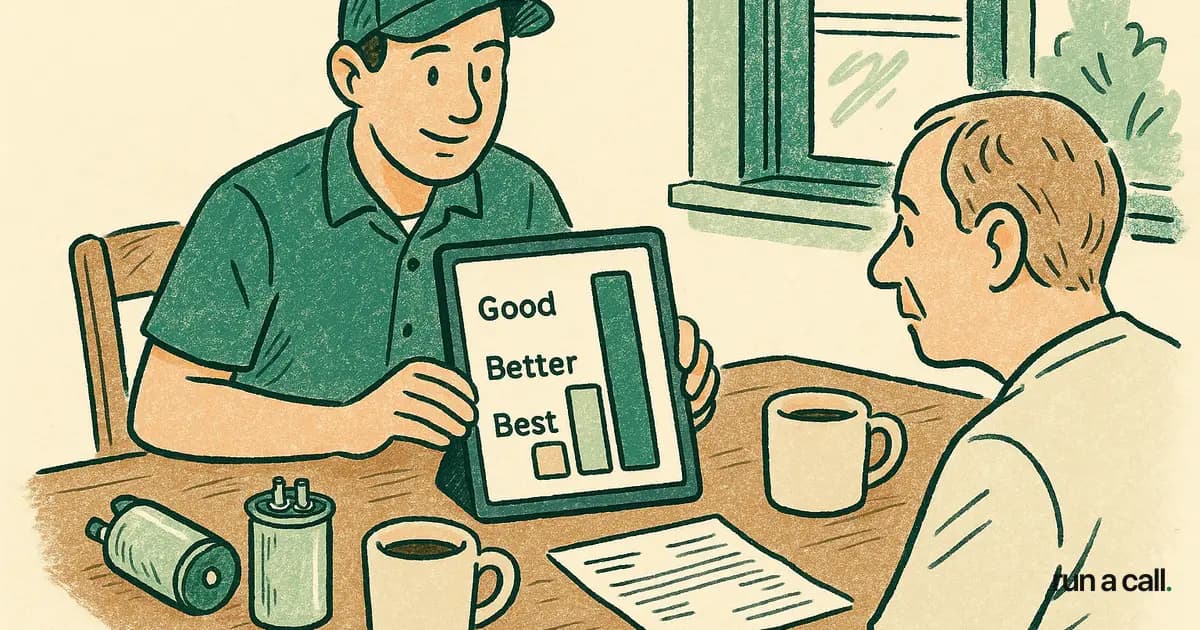
The marketing job is making membership the default, not an upsell. The technician at the kitchen table should present membership as part of the recommendation, not as a separate pitch at the end. Good-better-best (GBB) presentations work because membership is baked into the "better" and "best" tier — the customer is choosing a service level, not deciding whether to subscribe.
Price membership so the tech can sell it in 30 seconds. "$19 a month gets you two tune-ups a year, 15% off any repair, and you skip the diagnostic fee" beats a 12-tier program with seasonal coupons and a points system nobody understands. Simple sells. Complicated sits in a binder.
The second-year retention rate is the metric that matters. If your year-2 retention is below 70%, you have a service problem dressed as a marketing problem. The tune-up appointment is the marketing event — that's where the tech checks the capacitor, talks the homeowner through the SPP curve, photographs the rusted condenser coil, and plants the change-out conversation for next summer. Skip that visit and the member churns.
Marketing to existing members costs almost nothing. Two seasonal emails. A renewal text the day before billing. A birthday-of-the-system email at the 10-year mark — "Your system turns 10 this October. Here's what to expect." The shops that print money on membership aren't the ones with the slickest branding. They're the ones whose dispatch software actually triggers the renewal sequence without anyone having to remember.
What should an HVAC owner track to know marketing is working?
Three numbers, weekly: cost-per-booked-call by source, booked-call-to-run-call conversion, and revenue-per-run-call. If you know those three by source, you're ahead of 80% of shops. If you don't, that's your first project.
Lead source has to be captured at the call, not guessed at the end of the month. The dispatcher asks "how did you hear about us?" on every call, types it into the same field every time (a dropdown, not free text), and that field has to flow through to the closed job so you can tie revenue back to source. "Google" is not a source. "LSA", "Google Search ad", "Google organic", and "Google Business Profile" are four different sources with four different costs.
The second number — booked-call-to-run-call conversion — catches the silent killer. A shop can have great marketing and lose 30% of booked calls to no-shows, reschedules, and dispatcher errors before the truck rolls. If your booked-to-run is below 90%, fix dispatch before you spend another dollar on ads. We wrote a separate guide on what 5-25 tech shops actually need from their HVAC dispatch software — that's where most of the leak hides.
Revenue-per-run-call is the close-rate-times-average-ticket number. A shop with a $450 average ticket and a 30% replacement close rate is in a different business than a shop with a $280 average ticket and a 15% close rate. Marketing dollars at the first shop pay back. Marketing dollars at the second shop fund the agency, not the trucks. If your revenue-per-run is weak, more leads won't save you — better techs, better pricebook, better kitchen-table process will.
Attribution doesn't have to be perfect. It has to be consistent. A shop that captures source on 95% of calls in the same dropdown, every week, will out-decide a shop with a fancy attribution tool that nobody trusts. Pick the simple version, run it for 90 days, and let the numbers tell you where to spend the next dollar.
Where does software fit into HVAC marketing?
Software is not marketing. But bad software kills marketing faster than any agency mistake. If your dispatch board can't show the dispatcher who called and which ad they came from, you're flying blind. If your invoicing can't tag a job with its lead source, you can't measure ROI. If your customer database can't pull "members up for renewal next month", retention marketing doesn't happen.
The shops I see winning on marketing are running software that does three things well. Lead capture from every channel into one inbox — call, web form, LSA message, Facebook lead ad — with the source tagged automatically. Job records that carry the source through to revenue, so the weekly report writes itself. And a customer list that's actually queryable: members, last-visit-date, system-age, equipment-installed.
ServiceTitan does some of this, but at $245-$500 per tech per month plus $5-50K in setup fees, with a 6-12 month onboarding documented across BBB and Capterra reviews. For a 12-tech shop that's $35-72K a year before you've sent your first marketing email. We've covered the ServiceTitan alternative for HVAC tradeoffs in more depth — the short version: most 5-25 tech shops don't need an enterprise tool to run good marketing. They need one that captures source, ties it to revenue, and gets out of the way.
Whatever you run, the test is simple. Pull up your software right now and answer: how many booked calls came from LSAs last week? What was the average ticket on those calls? How many of them closed a replacement? If those three answers take longer than 30 seconds, the software is in your way.
Frequently asked
How much should an HVAC shop spend on marketing?
Most healthy 5-25 tech residential shops run between 5% and 10% of revenue on marketing. A shop doing $3M with a 30% close rate and a $450 average ticket can hold the lower end. A shop with a 20% close rate or a sub-$300 ticket needs to spend more — or fix the kitchen-table problem before pouring more money into ads. Track cost-per-booked-call, not cost-per-click.
Are Google Local Services Ads worth it for HVAC?
Yes, for most residential shops, LSAs are the highest-intent paid channel available. You only pay for calls and messages, you get the Google Guarantee badge, and you rank above the standard search ads. The catch: you have to keep your response time, review velocity, and license/insurance docs current or Google demotes you. Treat LSA review collection as a daily ritual, not a quarterly project.
Should I do SEO or Google Ads first?
Ads first, SEO in parallel. Ads buy you cash flow this month. SEO is a 6-12 month build that pays for years. Run LSAs and a small Search campaign on your top 10 service+city combinations now. Start publishing service-area pages and getting Google Business reviews in week one. Don't wait six months for SEO to kick in before turning on demand.
What's the ROI on an HVAC membership program?
A maintenance member is worth roughly 3-4x a one-time customer over five years. They buy two tune-ups a year, they call you first when something breaks, and they convert to change-outs at 2-3x the rate of cold leads. The marketing job is making membership the default — not an upsell at the end of the call. Price it so the techs can sell it in 30 seconds.
Do I need a fancy HVAC website to compete?
No. You need a fast, mobile-first site with a phone number in the header, a booking form that actually works, schema markup for local business, and service-area pages for every town you cover. Skip the stock-photo hero, the chatbot, and the 12-page About section. The job of the site is to convert a Google click into a booked call in under 30 seconds.
Ready to switch HVAC software?
Walk through the dispatch board, pricebook, and mobile app in 30 minutes. No commitment.

Co-founder of run a call. Owns product and operations. AI Strategist; built and sold an AI process-automation firm; before that ran transformation programs at HP.
Read full bio →