HVAC Pricebook: Build One Your Techs Will Actually Use.

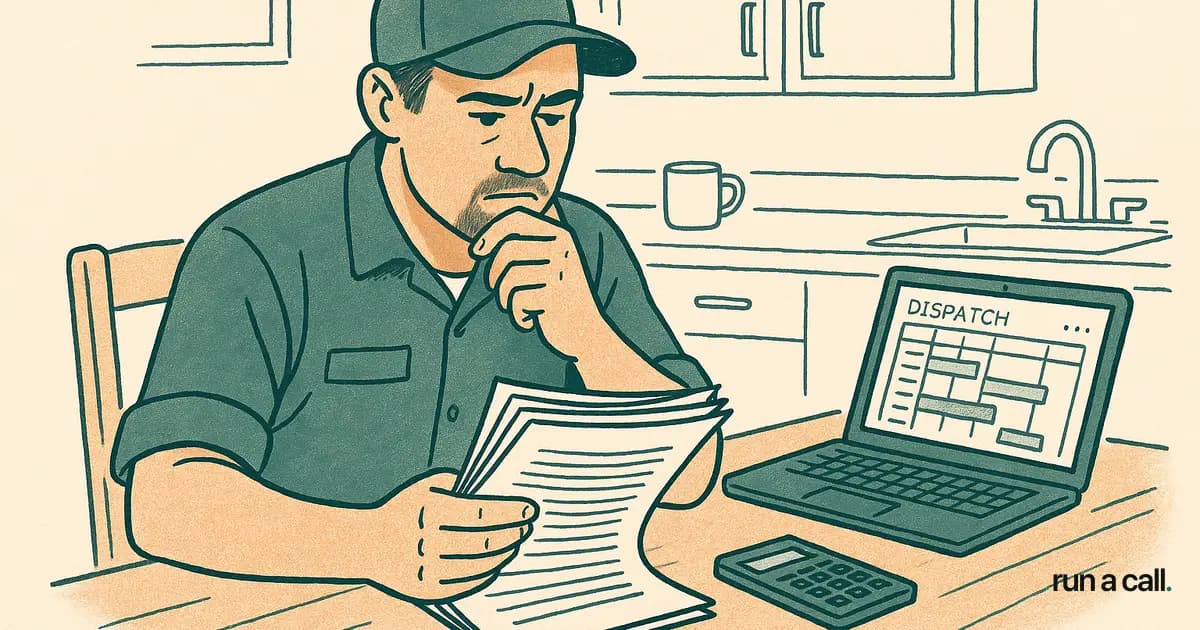
42% of ServiceTitan customers never finish setting up their pricebook. That's not a typo and it's not a slam — it's what shop owners say in the Facebook groups when nobody from sales is in the room. I grew up in my dad's residential HVAC shop. I watched him quote a blower motor on the back of an invoice, in pen, while the customer made coffee. The pricebook lived in his head. That worked when he ran two trucks. It does not work at five trucks, and it actively burns money at fifteen. This piece is what I'd tell him today if he were standing up an HVAC pricebook from scratch — what to put in it, what to leave out, and why the software you pick matters less than the structure underneath.
What is an HVAC pricebook, really?
An HVAC pricebook is the menu your techs quote from at the kitchen table — a structured list of repairs, change-outs, IAQ add-ons, and maintenance agreements with a fixed price next to each one. That's it. It's not a database project. It's a sales tool.
The confusion starts because software vendors sell it as a database project. ServiceTitan ships you a 5,000-SKU starter library and tells you to "customize." Six months later you're still customizing. Meanwhile your techs are quoting capacitors off a sticky note in the van.
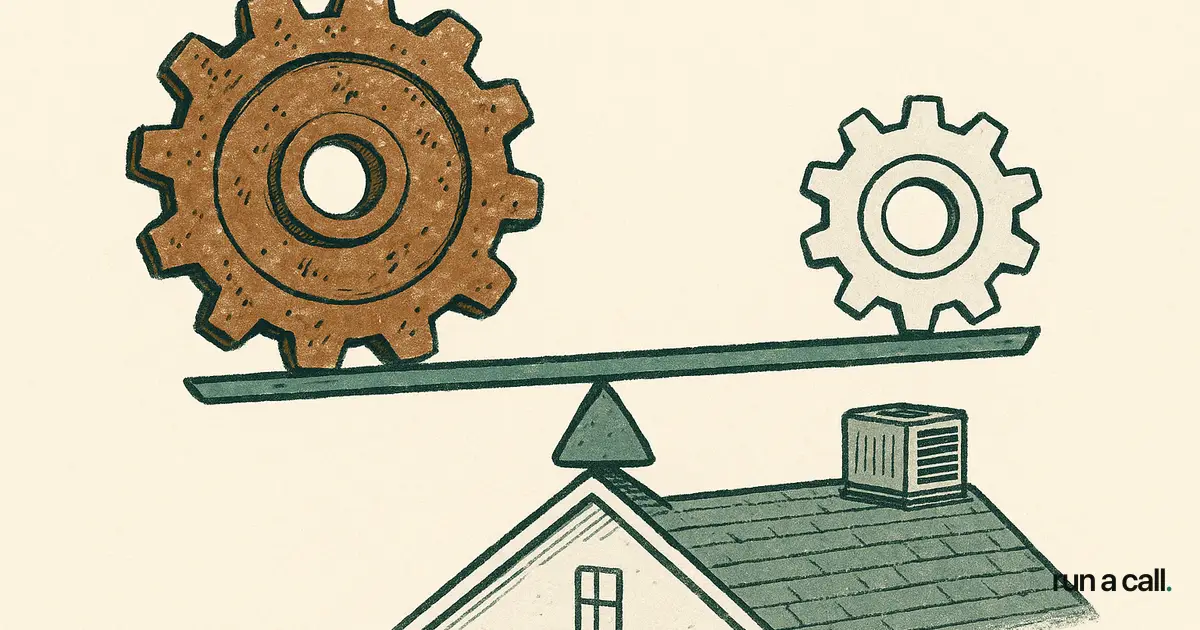
A good HVAC price book does three things. It gives the tech a number to say out loud without doing math in front of the homeowner. It protects your margin on the boring repairs you do every day. And it gives the homeowner a real choice on the change-out — good, better, best — instead of one number they have to either accept or reject.
If the pricebook in your software doesn't do those three things, the software is in the way. I'd rather see a shop running a tight 500-line pricebook in a spreadsheet than a 5,000-line mess in a $400/tech tool nobody trusts.
Why do 42% of ServiceTitan pricebook setups fail?
They fail because the structure is wrong before the data shows up. The 42% number comes from owner polls in HVAC Facebook groups — it's the share of ServiceTitan shops who never finish their pricebook build, even after paying $5,000-$50,000 in setup fees (BBB complaint history).
Here's what actually happens. A shop signs the contract. A ServiceTitan implementation rep ships them a Profit Rhino-style starter library with thousands of generic SKUs. The owner is told to "map your tasks" and "adjust your markups." Three months in, the dispatcher is still triaging support tickets and the techs are still using the old paper book.
The problem isn't the data. Profit Rhino's data is fine. The problem is that nobody on the implementation side asks the owner the only question that matters: what are the 30 repairs you actually run, this month, in this market? Without that filter, you're customizing a library built for a 200-tech shop in Phoenix when you're an 8-tech shop in Buffalo.
Median real onboarding on ServiceTitan runs 6-12 months per Capterra and G2 reviews, and the pricebook is the single biggest reason. Shops give up, go live with a half-built book, and the techs quote off memory anyway. You paid for the database. You did not get the sales tool.
This is fixable. But you have to build top-down — your top 30 repairs first, GBB change-outs second, everything else later — not bottom-up from someone else's library.
How to set up an HVAC pricebook from scratch
Setting up an HVAC pricebook starts with your last 200 invoices, not with a software vendor's starter library. Pull them. Sort by description. You'll find that 70% of your revenue comes from maybe 25-35 line items. That's your spine.
Week one: build the top 30 repairs. Run capacitor replace. Dual capacitor replace. Contactor replace. Blower motor (1/3, 1/2, 3/4 HP). Condenser fan motor. Ignitor. Flame sensor. Inducer motor. TXV replace. Refrigerant leak search. R-410A recharge by the pound. A2L recharge by the pound. Drain line clear. Float switch replace. Thermostat swap (basic, smart). Each one gets a flat-rate price that includes diagnostic, the part at your standard markup, and labor. No line-itemizing in front of the homeowner.
Week two: build the change-out tiers. Three tiers per tonnage — good, better, best. Don't make the customer choose between five SEER ratings. Make them choose between a 14-SEER builder-grade unit, a 16-SEER mid-tier with a better warranty, and a variable-speed 18+ SEER comfort system with a 10-year labor warranty and an IAQ package bundled in. Your close rate goes up because the middle option becomes the default — that's how good-better-best works.
Week three: ride along. Take the pricebook into the field with your two best techs. Watch them quote. Where do they hesitate? Where do they apologize for the price? Where do they go back to the van to "check on something" (which means: do math)? Every hesitation is a structure problem, not a price problem. Fix the language until the tech can say the number without flinching.
Week four: maintenance agreements and IAQ. Two membership tiers, max. One IAQ menu with five items (media filter, UV, polarized, humidifier, dehumidifier). Done. You can refine forever, but at four weeks you should be live and billing.
HVAC flat rate pricing vs time and materials
HVAC flat rate pricing is the practice of quoting one number at the kitchen table that includes diagnostic, parts at your markup, and labor — versus time-and-materials, where you bill the customer for hours worked plus parts at cost-plus. Flat rate wins on close rate and average ticket. T&M wins on simplicity and nothing else.
Here's the math my dad eventually accepted. A run capacitor costs you $14 from the supply house. At 4x markup that's $56. Add a $189 flat-rate diagnostic-and-repair labor charge and the customer pays $245. Their alternative on T&M is a $95 trip charge plus 1.5 hours at $145 plus the $14 part marked to $42 — that's $274 they have to mentally add up while the tech stands in the garage.
The $245 flat-rate number gets a yes faster. Every time. Because the homeowner isn't doing arithmetic — they're deciding whether to fix the AC. Take the math off their plate and the close rate climbs.
The other reason flat rate wins: techs stop apologizing. On T&M, every tech secretly knows the bill is going to surprise the customer, so they soften it on the way out. On flat rate, the price was on the tablet before any work started. The customer agreed. The tech just delivered. Nobody apologizes for delivering what was agreed.
The only legitimate case for T&M in residential HVAC is commercial-light work where the customer demands it. For everything else — capacitors, change-outs, IAQ, maintenance — flat rate is the answer. An HVAC flat rate pricebook is what makes that scalable beyond your two best techs.
What HVAC pricebook software actually needs to do
HVAC pricebook software needs to do four things, and most tools either underdeliver or overcomplicate. The four things: import your existing list without a consultant, surface the right SKU on the tablet in two taps, support good-better-best presentation natively, and update prices in bulk when your supply house raises costs.
Import without a consultant. If your pricebook software charges $5,000-$50,000 in setup fees per BBB filings just to get your data in, that's a tell. Your CSV is not that complicated. On Run a Call we take whatever you have — Profit Rhino export, Coolfront list, the spreadsheet your bookkeeper maintains — and clean it with you on a screen-share during onboarding. Days, not months.
Two taps to the right SKU. The tech is in the attic. The capacitor is bulged. They need "dual run capacitor 45/5 replace" on the screen in two taps from the work order. If your software makes them search a 5,000-SKU library by typing on a phone, you've already lost. The fix is hierarchy: top 30 repairs pinned, then category, then full search.
Native GBB. The tablet should present three options side by side at the change-out, not three separate quotes the tech has to flip between. The middle option should be visually defaulted. This is a sales-tool decision, not a database decision, and most software gets it wrong because the product team has never sat at a kitchen table.
Bulk price updates. R-410A goes up 18% over a quarter. Copper goes up. Your distributor raises blower motors. You should be able to bump a category by a percentage in one action, not edit 200 line items by hand. If you're an owner shopping a ServiceTitan alternative for HVAC, test this exact workflow in the demo. Most tools fumble it.
How a 12-tech shop rebuilt its pricebook in two weeks
A shop I worked with last spring ran 12 techs in the Carolinas. They'd been on ServiceTitan for 14 months. Their pricebook was 4,200 SKUs, half of which nobody had ever quoted. Average ticket was stuck at $487. Close rate on change-outs was 31%.
We pulled their last 180 invoices on a Tuesday. By Friday we had a real top-30 list — 28 repairs, actually, because two of the "top" SKUs in their old book hadn't been quoted in a year. We rebuilt those 28 with fresh flat-rate pricing using a 4x parts markup and a $189 base labor flat. Took six hours.
Week two we did the GBB change-out rebuild. Three tiers per tonnage, 2-ton through 5-ton, with the middle tier visually defaulted on the tablet. The owner pushed back on the top-tier price — said it was too high. I asked him when he'd last sold one. He said never. I said: that's the point. The top tier exists to make the middle tier feel reasonable. He kept it.
Ninety days later: average ticket $612, up 26%. Close rate on change-outs 44%, up 13 points. Same techs. Same trucks. Same market. Different pricebook structure.
The lesson isn't "raise your prices." The lesson is that the structure of the book — what's on it, how it's tiered, how fast the tech can quote it — drives more revenue than the prices themselves. A clean 500-SKU HVAC pricebook beats a sprawling 5,000-SKU one every time.
That's also why I don't buy the argument that you need a 6-month implementation to do this right. You need two weeks of focused work with someone who's sat in the dispatcher's chair. The rest is software.
Frequently asked
How many SKUs should an HVAC pricebook have?
For a 5-25 tech residential shop, 400-800 line items is plenty. That covers your top 30 repairs (capacitors, contactors, blower motors, ignitors, TXVs), your IAQ menu, maintenance agreements, and three good-better-best change-out tiers per tonnage. Anything past 1,500 SKUs and your techs start scrolling instead of selling. The 5,000-SKU pricebooks ServiceTitan ships out of the box are why 42% of shops never finish setup.
What's the right markup on HVAC parts?
Most healthy residential shops run 3x-5x on parts under $100 and 1.8x-2.5x on parts over $500, then layer flat-rate labor on top. A $14 run capacitor at 4x is $56 in parts plus a $189 diagnostic-and-repair flat rate — that's your $245 capacitor call. Don't quote parts and labor separately at the kitchen table. Quote the job.
How long does it take to build an HVAC pricebook from scratch?
Two to four weeks of focused work if you do it right: one week pulling your last 200 invoices to find your real top 30, one week building the GBB change-out tiers with your distributor reps, and one week doing tech ride-alongs to pressure-test the language. On Run a Call we import your existing list and have you billing the same week. Refining is ongoing — but you don't need to wait six months to go live.
Can I import my existing HVAC pricebook into Run a Call?
Yes. CSV import, Excel, or whatever you have. We'll take a Profit Rhino export, a Coolfront list, or your bookkeeper's spreadsheet. If it's messy we clean it with you on a screen-share — that's part of onboarding, not a $5,000 add-on. Most shops are quoting from the new pricebook in under a week.
Do I need flat-rate pricing or can I keep doing time-and-materials?
You can keep T&M, but your close rate and average ticket will both lag. Flat-rate pricing in HVAC isn't about hiding labor — it's about giving the customer a number at the kitchen table without your tech doing math in front of them. Shops that switch to flat-rate typically see average ticket climb 15-25% in the first 90 days, mostly because techs stop apologizing for the bill.
Ready to switch HVAC software?
Walk through the dispatch board, pricebook, and mobile app in 30 minutes. No commitment.

Co-founder of run a call. Owns product and operations. AI Strategist; built and sold an AI process-automation firm; before that ran transformation programs at HP.
Read full bio →