ServiceTitan ETF: What HVAC Shops Actually Pay to Leave.
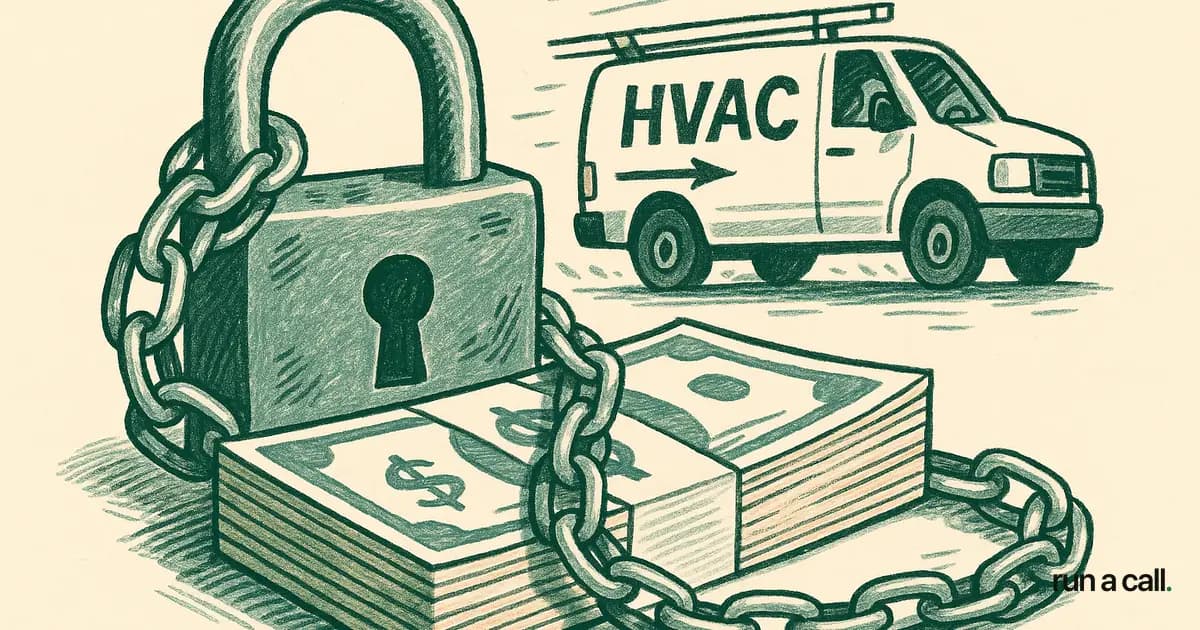
One HVAC owner in a BBB filing wrote a single check for $46,170 to walk away from ServiceTitan. Another paid $40,000. A third paid $39,375. These are not worst-case hypotheticals — they are documented early termination fees pulled from BBB complaints filed by real residential HVAC shops. ServiceTitan holds a 1/5-star BBB rating across 32 reviews and 27 complaints, and the ETF is the single most common reason owners file. If you signed a 12-to-24-month ServiceTitan contract and you are doing the math on what it costs to cancel, this article gives you the real numbers, the contract mechanics behind them, and what your exit actually looks like — including what shops are moving to after they pay out.
What Is the ServiceTitan ETF and How Is It Calculated?
The ServiceTitan early termination fee is 100% of the remaining contract value — not a fixed dollar amount. That means if you have 14 months left on a $500/technician/month contract with 10 techs, you owe $70,000 the day you want out.
ServiceTitan prices typically run $245–$500 per technician per month, plus a setup fee of $5,000–$50,000 billed at signing. Contracts are 12–24 months. The ETF clause does not scale down month-over-month the way a phone carrier early-exit fee does — it captures every remaining dollar on the term.
The BBB filings make the math concrete. Four documented ETF amounts paid by HVAC shops: $46,170, $40,000, $39,375, and $24,000. Those are not legal-threat numbers that got negotiated down. Those are amounts shops confirmed they paid, or were being pursued for, at the time of filing.

Why Do Shops Try to Cancel ServiceTitan Mid-Contract?
The most common reasons cited in BBB complaints fall into three buckets: reliability, pricing surprises, and onboarding failure.
On reliability, ServiceTitan averages 2.9 outages per month with a 188-minute average resolution time, tracked across 110 incidents since January 2023. For a residential HVAC shop running a dispatch board in the summer, a 3-hour outage on a 95-degree day is not a minor inconvenience — it is missed calls, hand-written tickets, and callbacks you cannot schedule.
On pricing, many shops sign based on a per-tech quote and discover later that add-on modules — marketing, reporting, scheduling pro — carry separate line items. The contract locks you into the full term regardless. On onboarding, ServiceTitan's own documentation lists a 6-to-12-month onboarding window. Shops that expected to be live in 30 days are paying for a system they cannot yet use while also paying to keep their old process running in parallel.
How to Cancel ServiceTitan: The Actual Process
To cancel ServiceTitan, you must submit written notice before the contract auto-renews — the window is typically 30–90 days before your renewal date, spelled out in Section 6 or Section 8 of your MSA depending on your contract version. Miss that window and you are locked into another full term.
Start by pulling your Master Services Agreement. Find the auto-renewal notice clause and the ETF definition. Calculate your remaining months times your monthly contract amount — that is your worst-case exposure. Then contact your ServiceTitan account executive in writing (email with read receipt) stating your intent to cancel and requesting the exact ETF balance in writing.
Some shops have successfully negotiated the ETF down by 20–40% — especially if they can document service failures, outages during critical operating periods, or onboarding delays caused by ServiceTitan's team. The BBB complaint process itself has moved some resolutions. Filing a complaint does not guarantee a reduction, but it creates a paper trail that account executives are instructed to escalate. Do not pay anything until you have the final ETF amount confirmed in writing.
What HVAC Shops Move to After Leaving ServiceTitan
After paying an ETF, most shops are not willing to sign another multi-year contract with per-tech pricing. The common landing spots are Jobber, Housecall Pro, FieldEdge, Service Fusion, and Run a Call — each with a different trade-off.
Jobber and Housecall Pro are lighter-weight and month-to-month, but their dispatch boards are built more for general field service than for residential HVAC specifically. FieldEdge has HVAC-specific pricebook depth but still runs per-tech pricing. Service Fusion is flat-rate but its mobile app has drawn the same kind of field complaints you see in ServiceTitan's 2.6/5 Google Play rating (960+ reviews).
Run a Call is built specifically for residential HVAC shops with 5–25 techs. It runs at one flat monthly price per shop — no per-tech fees, no setup cost, no annual contract. The dispatch board includes explainable AI dispatch with thumbs feedback, QuickBooks Desktop sync, Stripe Connect payments, and Twilio SMS. For the full side-by-side, the servicetitan alternative for hvac breakdown covers each competitor in detail.
Running a Parallel Migration While You Are Still Under Contract
If you have months left on your ServiceTitan contract and cannot afford the ETF today, a parallel-run migration is the right move. You keep ServiceTitan live for dispatch and billing until your contract term ends, while simultaneously onboarding your next software so your team is trained and your pricebook is loaded before day one.
The mechanics: export your customer CSV, equipment history, and job history from ServiceTitan now — while you still have access. Most alternatives, including Run a Call, accept a standard CSV import. Load your pricebook into the new system and run a handful of real jobs through it with one or two techs as a soft test. By the time your contract ends, your team has already used the new board on live jobs.
This pattern eliminates the most common migration failure: switching cold on day one with an untrained team and an empty pricebook. At Airbus I watched a €6M systems migration fail because two teams switched at the same moment with no overlap period. Field service software migrations fail the same way. Run the overlap, then cut over.
Is the ServiceTitan ETF Ever Worth Paying?
Sometimes, yes. If your current monthly ServiceTitan spend is $8,000–$12,000 and you can replace it with a flat monthly price per shop, the payback period on a $24,000 ETF is under 3 months of savings. A $40,000 ETF takes about 5 months. Run the actual arithmetic before assuming the ETF is a wall.
The calculation that matters: (Current monthly ServiceTitan cost) minus (new monthly cost) equals monthly savings. Divide the ETF by monthly savings to get payback months. If your savings are large enough, paying the ETF is cheaper than riding out a bad contract for another 12 months.
The shops that regret paying the ETF are the ones who switched to another per-tech, annual-contract tool and ended up in the same position two years later. If you are going to absorb an exit cost, move to a month-to-month structure on the other side so you are never in this position again. To see the full range of options before you decide, walk through Run a Call and compare it against what you are paying now.
Frequently asked
How much is the ServiceTitan early termination fee?
The ServiceTitan ETF equals 100% of your remaining contract value — not a flat fee. Documented amounts paid by HVAC shops in BBB filings include $46,170, $40,000, $39,375, and $24,000. Your specific amount depends on your per-tech rate, number of techs, and months remaining on your 12-to-24-month contract.
Can you negotiate the ServiceTitan ETF down?
Some shops have negotiated reductions of 20–40%, particularly when they can document service outages, onboarding failures caused by ServiceTitan's team, or other material breaches. Getting the negotiation in writing matters — do not agree to a verbal reduction. Filing a BBB complaint has moved some resolutions, though it does not guarantee a lower number.
What happens if you just stop paying ServiceTitan?
ServiceTitan will pursue the full ETF as a collections matter and can move to legal action for breach of contract. Your customer data access may be cut off immediately upon non-payment. Export your customer CSV, pricebook, and job history before you stop paying anything — you need that data regardless of how your exit plays out.
What is the best ServiceTitan alternative for a small HVAC shop?
For residential HVAC shops with 5–25 techs, the strongest alternatives are Run a Call (one flat monthly price per shop, no annual contract), Housecall Pro (lighter dispatch, month-to-month), and FieldEdge (HVAC pricebook depth, but per-tech pricing). The right pick depends on whether your pain with ServiceTitan is price, reliability, or contract lock-in. The full comparison is in our [servicetitan alternative for hvac](/learn/articles/servicetitan-alternative-for-hvac) breakdown.
How long does it take to migrate off ServiceTitan?
A parallel-run migration typically takes 30–60 days. Export your customer and job history from ServiceTitan, import to your new tool, load your pricebook, and run a small batch of live jobs with one or two techs before your full cutover. Shops that try to switch cold in a single day — with no overlap and an untrained team — are the ones that call the old software back in week two.
Ready to switch HVAC software?
Walk through the dispatch board, pricebook, and mobile app in 30 minutes. No commitment.

Co-founder of run a call. Owns engineering. €6M of operational systems at Airbus, then an AI workflow-automation firm acquired by Transputec, now Head of Enterprise Automation there.
Read full bio →