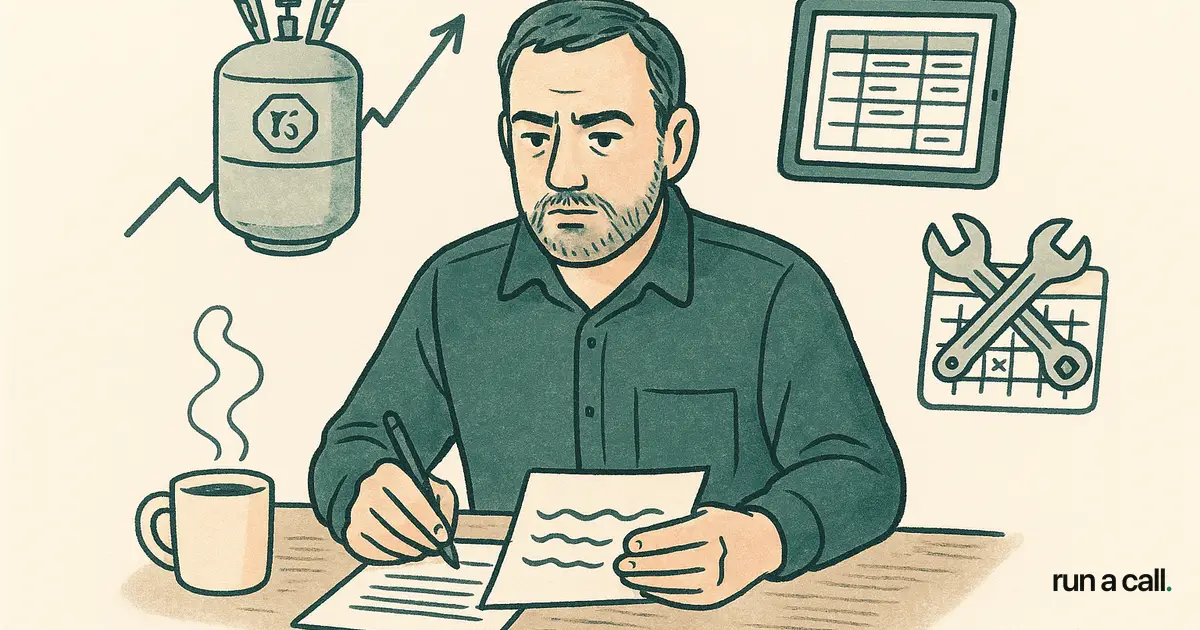
HVAC Flat Rate Pricebook: Build One That Closes Jobs.

A technician standing in a homeowner's kitchen, sweating through an awkward silence while he tries to remember what the office charged last time for a capacitor swap — that's what life looks like without a flat rate pricebook. Flat rate pricing replaces that guesswork with a single number the tech presents confidently, and research from shops that make the switch consistently shows average tickets climb $80–$150 per job once techs stop under-quoting. The hard part isn't understanding flat rate. The hard part is building a pricebook that's complete enough to cover 90% of your call types, priced right for your market, and structured so your techs can actually use it in the field. This guide walks you through exactly that.
What Is an HVAC Flat Rate Pricebook?
An HVAC flat rate pricebook is a menu of fixed prices for defined tasks — capacitor replacement, TXV swap, A-coil change-out, mini-split installation — where the customer pays the same price regardless of how long the job takes. The tech presents a number, the customer says yes or no, and there's no renegotiation when the job runs long.
The alternative — time-and-materials billing — means every job is a negotiation. The customer watches the clock, the tech rushes, and you eat the callbacks when something gets missed. Flat rate transfers the scheduling and efficiency risk back to you as the operator, which is exactly where it belongs.
For a deeper look at pricebook fundamentals, the full hvac pricebook guide covers the theory. This article focuses on structure and execution.

Why 42% of Shops Never Finish Their Pricebook
In a survey of shops that attempted pricebook setup inside ServiceTitan, 42% never completed it — not because they ran out of motivation, but because the structure defeated them before they entered a single price. They opened the software, saw a blank database asking for part numbers, labor codes, and tax rules all at once, and closed the tab.
The blocker is always structure, not data. Operators try to import their entire inventory first — every capacitor SKU, every filter size, every pound of R-410A — before they've defined a single customer-facing task. That's backwards. A pricebook is a task menu, not a parts catalog.
The right starting point is 30–40 task codes that cover your actual call mix: diagnostic fee, capacitor replacement (single/dual run), contactor swap, TXV replacement, A-coil change-out, refrigerant recharge by pound, blower motor, basic tune-up, and your top 5–10 IAQ add-ons. Price those tasks, get them in front of techs, and expand later. A pricebook your team uses beats a pricebook that's theoretically complete.
How to Structure an HVAC Flat Rate Pricebook
Start with four top-level categories: Diagnostics & Service Calls, Repairs, Replacements & Change-Outs, and Maintenance & IAQ. Every task code you ever create lives in one of those four buckets. Techs know exactly where to look; dispatchers know what category to expect on each call type.
Under Repairs, break by system: cooling repairs, heating repairs, refrigerant work. Under Replacements, break by equipment type: air handlers, condensing units, RTUs, mini-splits. This matters because your labor rates and parts margins can differ significantly between a residential mini-split install and a rooftop RTU swap — and your pricebook should reflect that without making techs do math.
For each task code, you need four fields at minimum: task name (customer-visible), task description (tech notes), flat price, and membership price (if you run a service protection plan). That's it to start. Add part links and truck stock flags later once the core 40 tasks are live and field-tested.
Good-Better-Best HVAC Pricing: Where the Real Money Is
Good-better-best (GBB) presentation is the single highest-return change most residential HVAC shops can make to their pricebook. Instead of presenting one price for a condenser replacement, the tech presents three: a base-model swap, a mid-efficiency upgrade with a warranty bump, and a top-tier system with an IAQ package and 10-year parts coverage. Done right, 30–40% of customers choose middle or top.
The kitchen table is where GBB lives or dies. A comfort advisor or senior tech presents the three options on a tablet or printed sheet, explains the difference in plain terms — "the good option fixes today's problem; the best option means you won't be calling us for a decade" — and lets the homeowner choose. No pressure, just options. Average ticket on a straight change-out runs $4,000–$6,000 in most markets; a GBB close at the middle tier routinely adds $800–$1,200 to that number.
Your pricebook needs to support GBB natively — meaning each replacement task code should have three price variants preloaded, not three separate task codes. If your tech has to search for "System Replacement – Premium" separately from "System Replacement – Standard," they'll skip the upsell half the time. Build the tiers into the task, not around it.
Setting Your Flat Rate Prices: The Math Behind the Menu
Every flat rate price needs to cover four things: parts cost, burdened labor (wage + taxes + benefits + truck), overhead allocation, and target margin. Most residential HVAC shops run 50–60% gross margin targets on repairs and 35–45% on equipment-heavy change-outs where the unit cost dominates.
Here's a simple sanity check for a repair task. Take your parts cost, double it (that's your parts-at-retail floor). Add burdened labor hours — for a capacitor swap, that's roughly 0.5 hours at a $75–$90 burdened rate, so $37–$45. Add your overhead allocation (divide total monthly overhead by billable hours, then multiply by time on task). If that math gets you to $180 for a dual run capacitor swap, and your market comps are $195–$220, you're priced right. If you're at $140, you're buying market share and losing margin.
Refrigerant pricing deserves special attention in 2026. With R-410A phasedown well underway and A2L refrigerants (R-32, R-454B) now standard in new equipment, your recharge pricing needs a line-item review at least quarterly. R-410A spot prices have moved significantly year-over-year; a pricebook you built 18 months ago may be costing you $30–$60 per recharge job in unrecovered cost.
HVAC Pricebook Software: What to Look For
The best pricebook software for a 5–25 tech residential HVAC shop does three things: it lets techs present prices in the field on any device, it ties task codes directly to dispatch and invoicing so nothing falls through the gap, and it doesn't require a 6-month onboarding before a tech can use it.
ServiceTitan has a full-featured pricebook module, but setup routinely runs 6–12 months per Capterra reviews — and that 42% never-finish rate tracks with what operators tell us directly. Housecall Pro and FieldEdge both offer pricebook features at lower price points, but their GBB presentation tools are limited. Jobber's pricebook is serviceable for simple shops but lacks the repair/replace task structure that HVAC specifically needs.
Run a Call ships a pre-loaded HVAC task library and GBB presentation built into the tech's mobile view — at one flat monthly price per shop for up to 25 techs, no per-seat fees. If you want to see how it compares head-to-head, the ServiceTitan alternative for HVAC page walks through the feature and price differences directly. You can also walk through Run a Call and have a working pricebook live the same day.
Frequently asked
What should an HVAC flat rate pricebook include?
At minimum: a diagnostic/service call fee, your top 30–40 repair task codes (capacitor, contactor, TXV, blower motor, etc.), refrigerant recharge by pound, your most common change-out packages with good-better-best tiers, and a maintenance/IAQ section covering tune-ups and add-ons like UV lights and media filters. Start with those and expand — a 40-task pricebook your techs use every day beats a 400-task pricebook nobody opens.
How do I price tasks in my HVAC flat rate pricebook?
Build each price from the ground up: parts cost + burdened labor (wage, taxes, benefits, truck allocation) + overhead per job + target margin. For repairs, most residential shops target 50–60% gross margin. For equipment-heavy replacements, 35–45% is more realistic. Run a quarterly review on refrigerant line items — R-410A and A2L pricing have moved significantly with the phasedown and new equipment standards.
What is good-better-best pricing for HVAC?
Good-better-best (GBB) is a three-tier presentation strategy where the technician or comfort advisor shows the homeowner three options — a base repair/replacement, a mid-tier upgrade, and a premium package — at the kitchen table or on a tablet. It removes the binary yes/no dynamic and typically lifts average ticket by $800–$1,200 on system replacements when 30–40% of customers choose the middle or top tier.
How long does it take to build an HVAC pricebook?
With the right starting structure, a working pricebook covering your top 30–40 call types takes one focused weekend. The mistake most shops make is trying to import every part and SKU before defining any customer-facing tasks — that's the path that leads to the 42% never-finish rate. Define your task codes first, price them, get them live, then add part links and truck stock flags over the following weeks.
Can I use an HVAC pricebook template instead of building from scratch?
Yes, and you should. A pre-built HVAC task library gives you the right category structure and common task codes out of the box — you customize prices for your market rather than inventing the framework. Run a Call ships a built-in HVAC template; Profit Rhino and The New Flat Rate are standalone pricebook products worth evaluating if you want a third-party data source. Either way, start with a template and adjust rather than starting from a blank spreadsheet.
Ready to switch HVAC software?
Walk through the dispatch board, pricebook, and mobile app in 30 minutes. No commitment.

Co-founder of run a call. Owns product and operations. AI Strategist; built and sold an AI process-automation firm; before that ran transformation programs at HP.
Read full bio →