HVAC Google Ads: A Shop Owner's Guide to Leads That Book.
$150. That's what a lot of 10-tech HVAC shops are paying per booked call through Google Ads — and half of them don't know it because nobody's tracking call bookings against ad spend. If your dispatcher is fielding 40 calls a day in July but you're still cutting checks to an agency that reports "impressions" and "clicks," this guide is for you. Google Ads and Google Local Services Ads are the two highest-volume paid channels for residential HVAC shops with 5 to 25 technicians. They are not the same product, they don't work the same way, and running them wrong costs real money. Here's how to run them right — and how to fit paid search inside a full lead-generation stack that doesn't collapse when the shoulder season hits.
Google LSA vs Google Ads: Which One Should HVAC Shops Run First?
Start with Google Local Services Ads if you haven't already. LSA puts your shop at the very top of the search results page — above standard ads, above the map pack — and you pay per lead, not per click. For residential HVAC, that typically means $20–$80 per lead depending on your market, your Google Guaranteed badge status, and the time of year.
Standard Google Ads (search campaigns) run on cost-per-click. You pay every time someone clicks your ad, whether they book or not. Well-run HVAC search campaigns in competitive metro markets land leads at $50–$150. Sloppy campaigns — broad-match keywords, generic landing pages, no negative keyword list — can push that to $200 or higher with nothing to show for it.
The practical answer for most 5–25 tech shops: run LSA first, get your Google Guaranteed badge, and treat that as your baseline lead flow. Add standard search campaigns once you know your close rate and can back-calculate what a click is worth to you. Running both without that data is guessing with someone else's money.
Setting Up HVAC Google Ads That Actually Convert
The single biggest mistake HVAC shops make with Google Ads is sending traffic to their homepage. Your homepage is about your company. A landing page is about the customer's problem right now — "my AC stopped working at 9pm in August" — and it answers that problem with a phone number, a booking link, and nothing else competing for attention.
Keyword structure matters more than most agency decks suggest. For HVAC, tight ad groups around service intent work best: "AC repair [city]", "furnace not heating [city]", "HVAC tune-up near me". Each group gets its own landing page. Broad match keywords like "HVAC" or "air conditioning" will drain budget on research queries from people who aren't buying anything today.
Negative keywords are where most shops leave money on the table. Before your campaign goes live, build a list: "DIY", "how to", "YouTube", "jobs", "careers", "parts", "wholesale". Revisit the search terms report every two weeks and add any irrelevant queries that are eating clicks. This single habit can cut wasted spend by 20–30% in the first 60 days.
Call tracking is non-negotiable. You need a tracking number on your ads that's different from your main line so you can tie calls to campaigns, see which ads are generating actual bookings, and fire your agency if they can't prove it. Google's built-in call reporting is a start, but pairing it with your dispatch software gives you the full picture: ad → call → booked job → revenue.
What Does an HVAC Lead Actually Cost on Google in 2026?
Cost benchmarks vary by market, but here's what shops in our network are seeing in 2026 across typical residential HVAC markets:
Google LSA: $20–$80 per lead. Competitive metros (Atlanta, Dallas, Phoenix) skew toward $60–$80 in peak season. Smaller markets and shoulder season pull this down.
Google Ads (search): $50–$200 per lead. A disciplined campaign with tight keyword groups and dedicated landing pages lands around $75–$120 in most mid-size markets.
Referral programs: Under $30 per lead, with the highest long-term value because referred customers close faster, complain less, and renew memberships at higher rates.
Direct mail: $15–$60 per lead in suburban and rural markets where digital competition is lighter. Works well for membership renewal campaigns and seasonal tune-up pushes.
The number that actually matters isn't cost per lead — it's cost per booked job. If your dispatcher closes 60% of inbound calls and your average ticket is $380, a $100 lead is worth taking. If your close rate is 35% and you're running emergency calls at $195, do the math before you scale the spend.
Membership Marketing: The Highest-ROI Channel Most Shops Ignore
Every HVAC owner I talk to has a membership program. Maybe 20% of them actively market it. The rest treat it like a line item on the invoice rather than the most important retention tool in the business.
A sold membership doubles customer lifetime value. It locks in two annual visits, moves a customer off the call-when-it-breaks cycle, and gives you a predictable revenue base that pays your fixed costs in October and March when the dispatch board thins out. A shop with 400 active members and a $180 annual plan is pulling $72,000 in recurring revenue before the first call comes in.
How do you market memberships without a dedicated budget? Three ways that actually work: (1) Train your techs to present the membership at every service call — not as an upsell, but as the answer to the customer's obvious next question ("how do I avoid this happening again?"). (2) Build a follow-up sequence after every repair that explains what the membership covers in plain numbers. (3) Run a Google Ads campaign specifically targeting your existing service area with membership messaging in the fall — CPCs are cheaper than peak season and you're targeting people who already know they have HVAC equipment.
For a deeper look at the full channel stack, the hvac marketing guide covers referral programs, SEO timelines, and direct mail segmentation alongside paid search.
How to Build an HVAC Lead Generation Stack That Survives Algorithm Changes
Shops that run only Google Ads are one policy change, one bid spike, or one competitor with a bigger budget away from a rough quarter. The shops that weather those changes have a stack — multiple lead sources that don't all break at the same time.
For a 5–25 tech residential shop, a healthy stack looks roughly like this: LSA handles emergency demand in peak season. Standard search covers specific service lines (mini-split installs, IAQ upgrades, change-outs) where you want to be present before the customer calls three competitors. Referral programs — even a simple $50 Visa card offer to existing customers — generate the highest-LTV leads with zero ongoing ad management. SEO is a 12–18 month play but every organic ranking you earn is a lead you don't pay for next summer.
Facebook and Instagram paid ads almost never make sense as a primary HVAC channel. They work occasionally for membership campaigns targeted to existing customer lists, but residential HVAC is a demand-capture business — people search when they have a problem, they don't browse social media hoping someone will tell them their capacitor is failing. Spend there only if you have budget left over after maxing LSA and search.
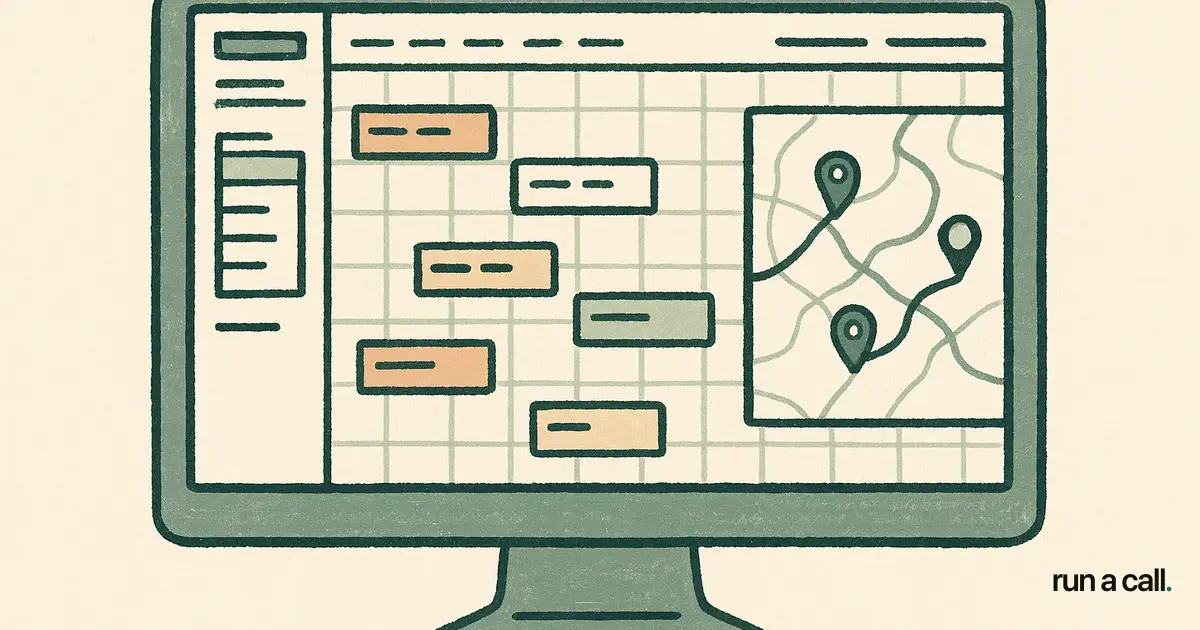
The dispatch software you run directly affects how efficiently you convert paid leads. If a $75 Google lead sits in a voicemail queue for 40 minutes while your dispatcher juggles a whiteboard, you've paid for a lead your competitor booked. A tight HVAC dispatch board is a marketing asset — it's what turns ad spend into revenue instead of missed calls.
What to Look for in HVAC Software if You're Running Paid Ads
If you're spending real money on Google Ads, your field software has to close the loop between the ad click and the job report. The two features that matter most: (1) call source tracking tied to the booking record, so you can see that a $65 LSA lead turned into a $420 repair job, and (2) job status visibility for your dispatcher, so no inbound call from a paid lead sits unanswered while your team is heads-down.
Run a Call is built for residential shops with 5–25 technicians — exactly the size where paid search is worth running but a bloated enterprise system creates more overhead than it solves. At one flat monthly price per shop, there are no per-tech fees that grow every time you hire someone. If you want to see how dispatch, pricebook, and job tracking fit together before committing, walk through Run a Call and form your own opinion.
If you're currently on a system that's making it harder to track lead ROI rather than easier, the ServiceTitan alternative for HVAC page walks through what the comparison looks like for a typical 10-tech shop — on cost, onboarding time, and day-to-day dispatcher workflow.
Frequently asked
How much should an HVAC shop spend on Google Ads per month?
There's no universal number, but a useful starting point is to work backward from your capacity. If your techs can handle 15 additional jobs per week and your average ticket is $350, you're looking at $5,250 in potential weekly revenue from incremental jobs. Spending $1,500–$3,000/month on Google Ads to fill that capacity is defensible math — spending $5,000/month to generate leads your dispatcher can't handle is not. Most 5–15 tech shops find their sweet spot between $1,000 and $4,000/month depending on market competitiveness and season.
What's the difference between Google LSA and Google Ads for HVAC?
Google Local Services Ads (LSA) appear at the very top of search results and charge you per lead — typically $20–$80 for HVAC. You need a Google Guaranteed badge, which requires a background check and license verification. Standard Google Ads (search campaigns) charge per click and appear below LSA. You control the keywords, ad copy, and landing pages, but you pay whether the click converts or not. LSA is simpler and often cheaper per lead; standard search gives you more control but requires more ongoing management to stay efficient.
Why aren't my HVAC Google Ads converting into booked jobs?
The most common causes: (1) Traffic is going to your homepage instead of a dedicated landing page for the specific service the ad promoted. (2) Your keyword match types are too broad and you're paying for research traffic, not buying intent. (3) There's no click-to-call or easy booking option above the fold on mobile. (4) Your dispatcher isn't answering inbound calls fast enough — a paid lead that hits voicemail often calls the next result. Fix the landing page first, tighten your keywords second, then look at your answer rate.
Do HVAC membership programs help with Google Ads ROI?
Yes, indirectly but significantly. When you close a Google Ads lead and convert that customer to a membership, the lifetime value of that $75 lead jumps from a single repair job to two annual visits plus priority service plus higher close rates on future change-outs. A customer with a membership calls you first when something breaks — they don't go back to Google. So the true ROI of your Google Ads spend includes however many of those customers you convert to members. Track membership conversion by lead source and you'll see which ad campaigns are actually building your business versus just filling the board.
Should HVAC shops run Facebook Ads instead of Google Ads?
For most residential HVAC shops, Google Ads (especially LSA) outperform Facebook Ads because HVAC is a demand-capture category — customers search when they have a problem, not while scrolling social media. Facebook can work for retargeting existing customers with membership offers or seasonal tune-up promotions, but as a primary lead source it typically delivers lower-intent traffic at higher cost per booked job. If you have a limited budget, max out Google LSA before spending anything on Facebook.
Ready to switch HVAC software?
Walk through the dispatch board, pricebook, and mobile app in 30 minutes. No commitment.

Co-founder of run a call. Owns product and operations. AI Strategist; built and sold an AI process-automation firm; before that ran transformation programs at HP.
Read full bio →